The California High-Speed Rail (CAHSR) project has reached a significant turning point in 2025, marking its most ambitious year since construction began. With more active construction zones, expanded environmental compliance checks, and strict equipment requirements, contractors are now operating in one of the most complex infrastructure environments in the United States.
For heavy equipment fleet managers, rental providers, and contractors, 2025 brings a new set of logistical, mechanical, and operational challenges—especially as California pushes for reduced emissions, higher productivity standards, and accelerated deadlines.
Current Construction Status (Q4 2025)
As of November 2025, construction packages CP 1–4 in the Central Valley show major visible progress, with several viaducts, underpasses, rail trenches, and structural foundations now in their final phases.
Updated Equipment Deployment Across Active Segments
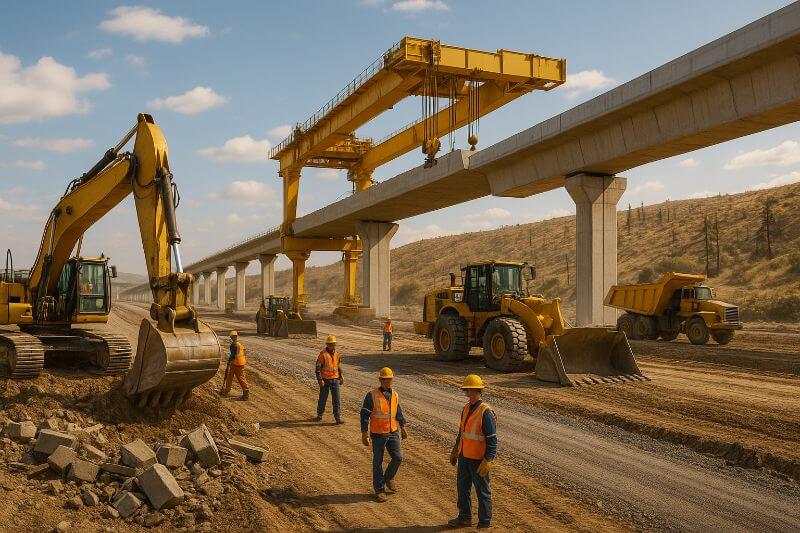
Across Fresno, Madera, Kings, and Tulare counties, the combined contractor fleets currently include:
- 48 excavators (CAT 349–395 range)
- 22 dozers (mostly D6–D9 for bulk earthwork)
- 35 articulated haul trucks
- 12 pile-driving rigs for deep foundation work
- 15 motor graders for grade prep and embankment leveling
- 9 cranes for beam placement and heavy lifting
- 30+ support units including water trucks, fuelers, mechanics trucks, and telehandlers
These numbers fluctuate weekly as contractors shift equipment between structural, utility relocation, and earthwork phases.
“We moved over 28 million cubic yards of dirt in the last two years alone,”
says Torres, “and the volume continues to grow as we open more corridors.”
Key Milestones Achieved in 2025
1. Completion of Major Viaduct Structures
Several large viaducts—including the Wasco Viaduct and the Cedar/Orange viaduct systems—have entered the final concrete pour and stress-testing stages.
2. Acceleration of Grade Separations
More than 70% of planned grade separations in the Central Valley are now structurally complete, reducing long-term traffic interference and supporting safer operational corridors.
3. Utility Relocations & Environmental Requirements
2025 saw heightened activity in relocating gas lines, fiber optics, and stormwater systems, requiring coordinated work between multiple state agencies and private utilities.
Equipment Requirements & Fleet Challenges in 2025
1. New Emissions Standards (Tier 4 Final Compliance)
California’s Air Resources Board (CARB) expanded regulations affecting:
- Off-road diesel equipment
- On-site engine reporting
- Fleet-wide emissions averages
Rental providers are under pressure to maintain Tier 4 Final and hybrid-capable fleets, as Tier 3 units face increasing restrictions within state-funded corridors.
2. Increased Demand for Large-Class Machinery
Bulk earthwork and foundation excavation require:
- 50+ ton excavators
- D8–D10 class dozers
- High-capacity scrapers
- Long-reach attachments for trench and channel work
However, supply remains tight, leading to higher rental utilization rates and extended booking lead times.
3. Operator Certification Requirements
Operators must show:
- OSHA 10/30 certification
- Class A/B license (for haul units)
- Pile-driving certification (for foundation rigs)
- Safety compliance with CAHSR’s unique operational guidelines
This impacts scheduling, as certified operators are in short supply.
Environmental & Operational Challenges
1. Noise and Vibration Restrictions
Construction in urban-adjacent areas requires real-time monitoring. Equipment with modified mufflers or electric assist is increasingly preferred.
2. Heat, Weather & Seasonal Impacts
Summers in the Central Valley have increasingly reached 42°C (107°F), affecting:
- Engine cooling efficiency
- Fuel consumption
- Operator rotations
- Equipment uptime
Manufacturers are responding with upgraded cooling packages and telematics-driven shutdown alerts.
3. Soil Stability & Foundation Complexity
Several segments require:
- Deep dynamic compaction
- Ground improvement using stone columns
- Over-excavation and subgrade replacement
These operations depend heavily on large dozers, compactors, and dedicated foundation rigs.
Fleet Logistics & Future Equipment Demand
Looking ahead to 2026–2027, CAHSR is expected to expand work zones into:
- Bakersfield north-south approaches
- Fresno metropolitan connectors
- Additional viaduct extensions and tunnel portals
This will dramatically increase demand for:
- Crawler cranes for major lifts
- High-horsepower excavators
- Low-bed transportation units
- Mobile batching plants
- Advanced telematics-equipped fleets
Heavy equipment providers and contractors who adapt early—especially those offering low-emission or hybrid machinery—will be best positioned for long-term CAHSR partnerships.
Conclusion
The California High-Speed Rail project’s 2025 progress demonstrates both the scale and complexity of building America’s first true high-speed rail system. With millions of cubic yards moved, dozens of structures completed, and multiple corridors advancing simultaneously, the project is entering a crucial acceleration phase.
For equipment providers, operators, and construction teams, understanding the evolving requirements—emissions, fleet capacity, operator certification, environmental compliance—is now essential to staying competitive.
As Torres summarizes:
“The rail may be high-speed, but the construction demands are even faster.
Every month brings new challenges, new equipment needs, and new milestones.”